This article contains affiliate links to Thomann, which helps us keep the blog running.
It often takes just a single note to recognize David Gilmour: a slow bend, endless sustain, an echo that carries the phrase out into space. The Pink Floyd guitarist has crafted one of rock’s most imitated sounds using a handful of fairly simple effects, applied with great taste.
First, we’ll explore what makes up Gilmour’s sound and how his gear has evolved, then break down his pedalboard pedal by pedal, including current versions and affordable alternatives. We’ll wrap up with the signal chain order, typical settings for his iconic songs, and an FAQ.
David Gilmour: One Sound, Three Major Eras
Gilmour’s sound is based on a powerful, clean tone with plenty of headroom (the margin before the amp saturates). His classic setup: 100-watt Hiwatt DR103 heads, 4×12 WEM cabinets, and the famous Black Strat. The character comes from the pedals, not from the amp’s distortion. A Yamaha RA-200 rotating speaker, mixed in fairly low, adds body to the overall sound.
His pedalboard has evolved significantly. We can distinguish three distinct periods:
- The Floyd Years of the ’70s (Meddle, The Dark Side of the Moon, Wish You Were Here, Animals): Binson Echorec, Uni-Vibe, Fuzz Face, Big Muff, Colorsound Power Boost, and MXR Phase 90. By 1976, everything was organized on a custom-made pedalboard by Pete Cornish.
- *The Wall* and the ’80s and ’90s: digital delays (MXR Digital Delay System I, then TC Electronic 2290), Electric Mistress, Boss CE-2, and Cornish P-2 circuits. In 1994, his main distortion pedal was a Sovtek “Civil War” Big Muff.
- On an Island, Rattle That Lock, and Luck and Strange (2006–2024): the return of the Ram’s Head Big Muff and the Electric Mistress, Tube Drivers, and modern compressors (Effectrode PC-2A, Origin Effects Cali76), and the Dawner Prince Boonar echo, a Binson clone.
This video takes a look at his pedalboards from 1977 to 2024:
David Gilmour’s Pedalboard, Pedal by Pedal
The Big Muff: The Heart of His Solos
If there’s one pedal that defines Gilmour, it’s the Big Muff. He has owned a Ram’s Head (mid-1970s version) since 1974–76, and a second Ram’s Head served as his touring Big Muff from 1977 to 2016, notably on “Comfortably Numb.” He also used Pete Cornish circuits derived from the Big Muff (the P-1 in 1976–77, the P-2 starting in 1988, and later the G-2) and a Sovtek Civil War in 1994. All of these versions are detailed in our feature on the different versions of the Big Muff.
Electro-Harmonix Ram’s Head Big Muff Pi

This is the compact reissue of the 1973 “purple” Ram’s Head V2, featuring Volume, Tone, and Sustain controls and true bypass. The Ram’s Head is known for having a more singing tone and more presence in the mids than the current NYC Big Muff. To get a sound closer to Gilmour’s, don’t crank the Sustain all the way up: he set his fuzz to a moderate level and let a booster finish the job. This is the first logical purchase for a Gilmour-style pedalboard.

 Electro Harmonix Ram’s Head Big Muff Fuzz€98Buy
Electro-Harmonix Green Russian Big Muff

For the Pulse sound, look to the Russian Big Muffs of the ’90s. The Green Russian isn’t exactly Gilmour’s Civil War circuit, but it belongs to the same family, with more bass and a thicker sound than the Ram’s Head. Same controls (Sustain, Volume, Tone), same compact design. A good choice if you prefer the Gilmour sound of the ’90s. EHX also offers a more feature-rich Sovtek Deluxe Big Muff Pi, which replicates the look of the Civil War.
 Electro Harmonix Green Russian Big Muff Fuzz€95Buy
Boost and Amp: Colorsound, Tube Driver, and Hiwatt
Gilmour’s fuzz sound owes a lot to his surroundings. In the 1970s, he used a Colorsound Power Boost (“Pigs,” “Sheep” on *Animals*), then starting in the 1990s, Tube Drivers (Chandler, then BK Butler), which are still in use on the 2024 tour. The booster is set right on the edge of saturation to provide compression and a smooth, mellow tone rather than sheer volume. For the order of the boosters and fuzz pedals, see our article on the order of gain pedals.
Crazy Tube Hi-Power Circuits

This Greek pedal pays homage to the sound of *Wish You Were Here*. On one side, it features a replica of the Colorsound Power Boost / Overdriver (Master, Volume, Bass, Treble, Boost or Overdrive mode). On the other side, it features an analog simulation of a 100 W or 50 W Hiwatt amp with a three-band EQ. A send/return loop lets you insert your Big Muff between the two, and the circuit runs internally on 18 V. Ideal if your amp isn’t a Hiwatt, or if you’re playing without an amp. We featured it in our article on the release of the Hi-Power.

 Crazy Tube Circuits HI-Power€271Buy
Compression: the Dyna Comp
Gilmour has been using compressors since the 1977 *Animals* tour, starting with an MXR Dyna Comp “script, ” then a Boss CS-2 in the ’80s and ’90s, and higher-end models on *Luck and Strange* (Effectrode PC-2A, Demeter Compulator, Cali76). For the basics, read “Exploring Compression Pedals.”
MXR Dyna Comp

Two knobs— Output and Sensitivity—and the percussive character typical of OTA compressors. Gilmour uses it to gain sustain in clean tones and, according to experts, to tighten up a Big Muff. A Sensitivity setting around 10–11 o’clock sounds natural; set it higher for sustained notes. To stay true to Gilmour’s setup, MXR also offers a Custom Shop Script Dyna Comp featuring the “metal can” CA3080 chip, which is slightly more expensive.
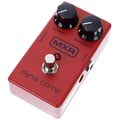
 MXR Dyna Comp 1976€109Buy
Modulation effects: chorus, flanger, Uni-Vibe, and phaser
Gilmour uses modulation sparingly, often to complement the rotating speaker: Uni-Vibe and phaser from 1972 to 1975, Electric Mistress from 1977 to 1983, and Boss CE-2 starting with The Wall tour. To understand this effect, read Exploring Chorus Pedals.
Boss CE-2W Waza Craft

Gilmour adopted the Boss CE-2 on The Wall tour in 1980–81 (using two units to widen the stereo image) and continued to use it through *Pulse*. The CE-2W is the current version, manufactured in Japan with a BBD analog circuit and three modes: CE-2, CE-1 chorus, and CE-1 vibrato. Starting point: Rate set to around 11–12 o’clock, Depth around 2 o’clock, for a slow, deep chorus on arpeggios. The go-to chorus for Gilmour in the ’80s and ’90s. The more affordable Mooer Ensemble King is often cited as a convincing clone of the CE-2.

 Boss CE-2w€225Buy
Mooer E-Lady

The Electric Mistress is the flanger Gilmour used on *Animals*, *The Wall*, and *The Final Cut*, and he was still using it on stage in 2015–16 and in 2024. Since originals are rare, the Mooer E-Lady is the alternative most recommended by fans for the sound of the Deluxe Electric Mistress. This mini analog flanger offers a Normal mode and a Filter mode, in the spirit of the original’s Filter Matrix. Set to a slow, subtle setting, it delivers that liquid texture heard in the arpeggios on *The Wall*. One of the best deals on this list.
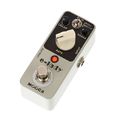
 Mooer E-Lady66 €Buy
MXR M68 Uni-Vibe

Between 1972 and 1975, Gilmour used an Univox Uni-Vibe—most likely on “Breathe” and “Time”—and returned to it as early as 1994 with a rack-mount version. The MXR M68 replicates the effect with Speed, Depth, and Level controls, plus a chorus/vibrato selector switch. It’s known for having a slightly brighter tone than the original. In chorus mode at low speeds, it recreates the swirling sound of the *Dark Side* era.
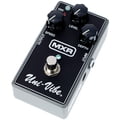 MXR M68 Uni-Vibe Chorus/Vibrato€154Buy
MXR 1974 Vintage Phase 90

The Phase 90 is associated with the four-note riff from “Shine On You Crazy Diamond”—played with the Dyna Comp—and with “Have a Cigar.” This reissue features the circuitry from the “script” logo era, which is known to be smoother than the “block” logo versions. There’s just one knob, Speed, which should be adjusted slowly for a subtle undulation. For “Shine On,” this is the pedal to have.
 MXR 1974 Vintage Phase 90€166Buy
Echoes: From the Binson Echorec to Digital Delays
Delay is Gilmour’s go-to effect; he doesn’t use reverb on stage, but rather several delay units. Until 1977, his main delay was a Binson Echorec, an Italian unit with a magnetic drum and multiple heads, producing a warm, diffuse sound. He then switched to digital with the MXR Digital Delay System I, followed by the TC Electronic 2290. To get the most out of this effect, check out our guide on how to use a delay pedal.
Catalinbread Echorec

It emulates the four-head Binson, with a 12-program selector that recreates its rhythmic patterns. The Swell control builds the repeats into an almost reverberant cloud. Delay from 40 to 1,000 ms, Tone and Mix controls, 9–18 V power supply. Some fans find it a bit dark compared to a real Binson, but it’s one of the most affordable ways to get close to the sound of *Echoes*.

 Catalinbread Echorec€261Buy
Dawner Prince Boonar Tube Deluxe Echo

This is the echo unit that Gilmour himself uses: the Boonar is part of his rack on the “Luck and Strange” tour. This version emulates the Binson Echorec Model 2 T7E, featuring four heads, four feedback knobs, and Swell, Drum Age, and Drum Speed controls. It also includes tap tempo, presets, and MIDI. A collector’s item, but the most highly regarded Binson clone on the market.
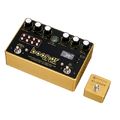
 Dawner Prince Boonar Deluxe Echo Tube€1,222Buy
TC Electronic 2290 P Dynamic Delay

The TC 2290 was a rack-mounted delay found in Gilmour’s rigs, as well as in The Edge’s. This pedal version features the same engine, with 128 presets, tap tempo with subdivisions, modulation, and stereo. It’s the ideal tool for recreating the precise digital delays Gilmour used in the ’80s and ’90s. It takes a little time to get the hang of it, but using one preset per song simplifies things on stage.
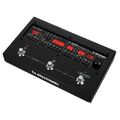
 tc electronic 2290 P Dynamic Delay Pedal€198Buy
Boss DD-8 Digital Delay

For a compact and affordable alternative, the Boss DD-8 does a great job of capturing the delay sounds from *The Wall* and the ’80s and ’90s. It features 11 modes, a looper, tap tempo via an external footswitch, and stereo inputs and outputs. Its four controls (Level, Feedback, Time, Mode) are all you need to recreate Gilmour’s signature delay settings. An excellent first delay pedal for this style.
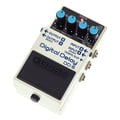 Boss DD-8 Digital Delay€179Buy
Other effects in his rig
The Heil talk box was used on the “Animals” sessions for “Pigs (Three Different Ones).” A Digitech Whammy and an Ernie Ball volume pedal are still on his pedalboard in 2024, and a Fuzz Face was on the board for “The Wall.”
In what order should you arrange the pedals, Gilmour-style?
Gilmour’s order varied: in 1977, the Dyna Comp was placed after the gain effects, then it moved to the beginning of the chain in the ’80s and ’90s. Here’s a simple chain inspired by his rigs:
- Compressor (Dyna Comp)
- Phaser or Uni-Vibe
- Big Muff
- Booster (Colorsound, Tube Driver, or Hi-Power)
- Chorus or flanger (CE-2W, E-Lady)
- Volume pedal
- Delays
Placing delay pedals after the volume pedal is a Gilmour trademark: the echoes continue even when you turn down the volume. To learn more, check out our guide to setting up your pedalboard correctly.
Typical Settings for a Gilmour-Style Sound
These starting points are inspired by analyses from the specialized website Gilmourish. They depend on your amp and pickups: trust your ears first and foremost.
The “Comfortably Numb” solo
Big Muff with Sustain set to around 70%, Tone between 30% and 40%, Volume around 50–60% (the settings provided by Gilmourish for his Big Muff from the Animals era), boosted by a mild booster. Add a digital delay of around 400 ms, mixed low, and possibly a very subtle chorus to evoke the rotating speaker.
Shine On You Crazy Diamond
For the four-note riff: Dyna Comp and a slow Phase 90 on a powerful clean tone. For leads, a Colorsound-style booster (the boost section of the Hi-Power) and a prominent Echorec-style echo.
“Run Like Hell,” “Another Brick in the Wall,” and “Echoes”
Run Like Hell: a digital delay set to around 380 ms, with about 7 repeats at the same level as the direct signal. Another Brick in the Wall (Part 1): closer to 440 ms, with a mix level of about 25–35%. Echoes: a Binson-style echo set to around 300 ms, with multiple repeats and a fairly high mix level.
FAQ: How to Sound Like David Gilmour
Which Big Muff does David Gilmour use?
Most notably a 1970s Ram’s Head—his go-to Big Muff on tour from 1977 to 2016. He also used the Pete Cornish P-1, P-2, and G-2 models, as well as a Sovtek Civil War in 1994.
Which pedal should you buy first to sound like Gilmour?
A Ram’s Head Big Muff and a good delay. These two pedals are enough to get close to most of his solos.
What amp did David Gilmour use?
Mainly 100-watt Hiwatt DR103 heads with WEM cabinets, often paired with a Yamaha RA-200. In 2024, he was playing Hiwatt Custom 50-watt amps and Alessandro amps.
What delay pedal for the Gilmour sound?
For the ’70s, a Binson-style echo (Catalinbread Echorec, Dawner Prince Boonar). For *The Wall* and the ’80s–’90s, a digital delay like the TC Electronic 2290 P or the Boss DD-8.
Does David Gilmour use reverb?
Not on stage: he prefers to stack multiple delays, which create space without muddying the sound.
Is the Crazy Tube Circuits Hi-Power enough?
It covers the Colorsound and Hiwatt setups from *Wish You Were Here*. For the solos, add a Big Muff in the loop and a delay at the end of the chain.
What chorus pedal does David Gilmour use?
The Boss CE-2, since The Wall tour in 1980–81. The CE-2W Waza Craft is the current version.
Can you sound like Gilmour on a budget?
Yes: a Ram’s Head, a Mooer E-Lady, and a Boss DD-8 cover a good portion of his repertoire for less than €350. The rest is all in the fingers.