This article contains affiliate links to Thomann, which help us keep the blog running.
Ethereal soundscapes, soaring echoes, rockabilly slapback, or cascades of post-rock repeats: the delay pedal is an endless playground, and it’s one of those pedals that’s practically a must-have on your pedalboard.
But between analog delays, digital delays, tape simulations, small three-button pedals, and MIDI stations, it’s hard to know where to start in 2026. Whether you’re a fan of Gilmour, The Edge, or shoegaze, we’ve updated this guide: what a delay is used for, how to choose one, and our selection of 17 current pedals, organized by budget and use—plus the new Strymon TimeLine MX, released this summer.
What is a delay pedal?
A delay pedal (echo, or “retard” in proper French, even though nobody says that) records your guitar signal and then plays it back after a short delay. The result: repetitions of your sound—spaced out more or less widely and in varying numbers—that you can shape in endless ways.
Delay can be subtle, to add depth, or downright psychedelic, to immerse your sound in an ocean of echoes. It also blends very well with other effects, starting with reverb. For the theoretical basics, our Effects Wiki article on delay traces the history of the effect, from echo chambers to tape machines.
Why use a delay pedal?
- Thicken your sound: a single short repeat (the famous slapback, around 80 to 120 ms) adds depth to a rhythm track.
- Creating atmospheres: a long delay combined with reverb, and you’re off on an interstellar journey.
- Bring out the solo parts: a few quiet rehearsals will give your notes that “studio” sound—fuller and more sustained.
- Playing rhythm: A delay set to the tempo (in dotted eighth notes, à la The Edge) creates patterns that you couldn’t play with just your right hand.
How does a delay pedal work?
The pedal records the audio signal and plays it back after a selected delay. You generally control three parameters:
- Time: the interval between repetitions, ranging from a few milliseconds to several seconds.
- Feedback (or Repeats, Regen): the number of repetitions, ranging from a single echo to self-oscillation.
- Mix (or Level): the volume of the playback relative to the live sound.
The more feature-rich pedals include modulation (a slight vibrato on repeats, very “tape-like”), tap tempo (tap the tempo with your foot to sync the delay to the song), subdivisions (eighth notes, dotted eighth notes, triplets), presets, MIDI, reverse, or a looper.
How to choose the right delay pedal?
Here are the things to look for before buying:
- Analog or digital? An analog delay using BBD (Bucket Brigade Device) chips has a warm, dark tone and repeats that fade beautifully, but a limited delay time (often 300 to 600 ms). Digital delay is cleaner, offers much greater range, and can emulate both analog and tape delay. Our article “Analog vs. Digital Pedals” breaks down this comparison in detail.
- Live or in the studio? At live shows, tap tempo, presets, and MIDI are game-changers. At home, a simple three-button pedal is often all you need.
- Your style: rock, country, ambient, psychedelic? Some delay effects are designed to cut through the mix, while others are meant to blend into the background.
- Mono or stereo: If you’re playing through two amps or directly into a mixer, a stereo delay (with ping-pong between left and right) really comes into its own.
- Pedalboard size and power supply: A mini pedal that draws 65 mA doesn’t require the same power supply as a unit that draws 500 mA. Check the power consumption before ordering.
The 17 Best Delay Pedals of 2026
We’ve stayed true to the spirit of our 2025 selection by ensuring that every pedal is still available for purchase, and we’ve expanded it to include more affordable models and a few new releases. The prices listed are those found at Thomann in November 2026; they change regularly.
1. Simple and Affordable Delays
Harley Benton Digital Delay

If you’re just starting out or need a quick fix for your board, it’s hard to find anything cheaper. The Harley Benton Digital Delay offers a digital delay ranging from 25 to 600 ms with the three essential controls, all housed in a metal enclosure that draws only 40 mA. It doesn’t have tap tempo or modulation, but it delivers a clean sound and crisp repeats, perfect for a slapback or a solo echo. With over a thousand reviews on Thomann, it’s one of the best-selling delays on the market. Price: about €30.
TC Electronic Flashback 2

The Flashback 2 remains one of the best values in digital delay. It features 8 algorithms (including tape and analog simulations), tap tempo, stereo inputs and outputs, and 3 TonePrint slots for loading artist presets from the TC app. Its pressure-sensitive MASH footswitch lets you adjust a parameter by pressing harder or softer. A pedal that covers almost every need for just over 100 €. Price: about 105 €.
JHS 3 Series Delay

The JHS 3 Series Delay gets right to the point: Mix, Time, and Repeats, plus a switch that toggles between clear, digital-style repeats and darker, analog-style echoes. With delay times ranging from 80 to 800 ms, it covers everything from slapback to longer, sweeping delays. It doesn’t have tap tempo, but it draws just 71 mA and is easy to use right out of the box. Ideal if you want a great delay without getting lost in menus. Price: about €114.
MXR Carbon Copy
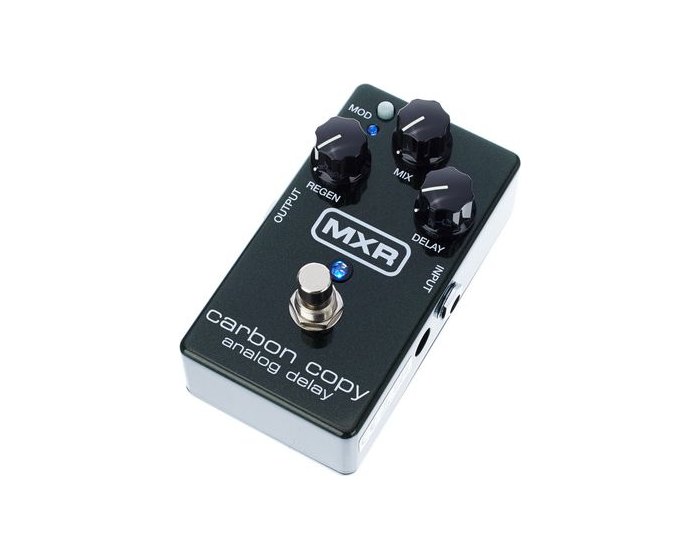
The Carbon Copy has become the go-to analog delay on thousands of pedalboards. It features three knobs (Regen, Mix, Delay), up to 600 ms of warm, dark repeats, and a Mod knob that adds subtle modulation for a worn-out tape sound. The repeats blend into the playing rather than doubling it, making it a perfect companion for blues and rock. Its reputation also stems from its rugged build. Price: approximately €175.
Boss DD-8
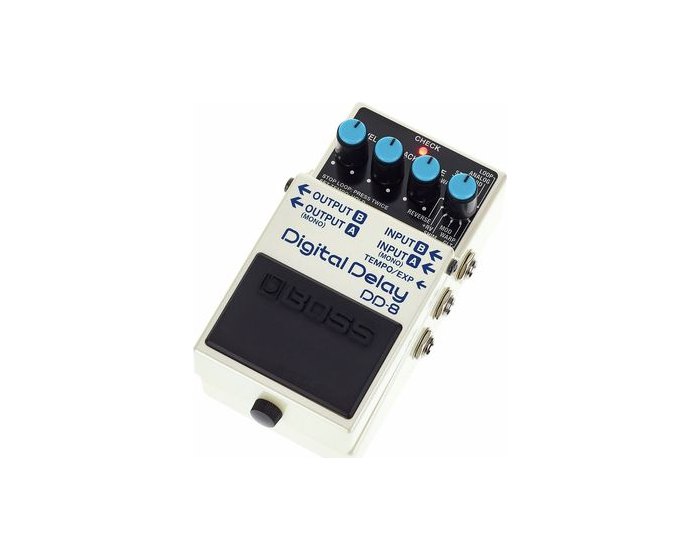
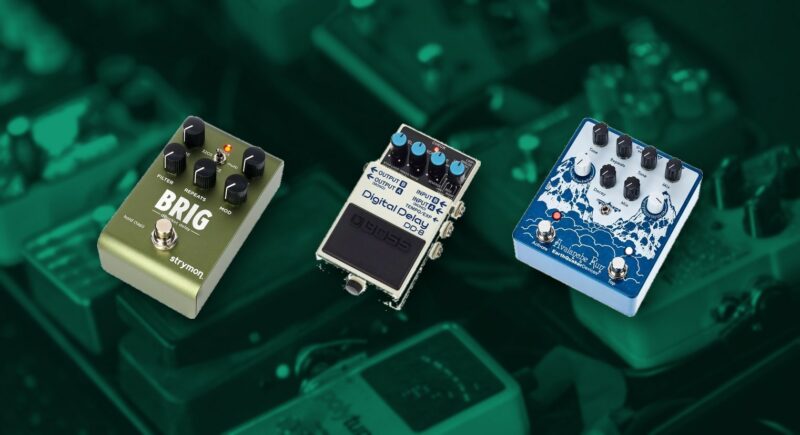
The DD-8, the latest in a line of pedals that began with the DD-2 in 1983, is Boss’s compact Swiss Army knife. It offers 11 delay modes (including analog, tape, shimmer, and reverse) and a looper mode, stereo outputs, and draws only 65 mA. Its classic Boss design fits anywhere, and its reliability is well-established. It’s often our top recommendation for a first delay pedal that will “last a lifetime.” Price: approximately €179.
2. Versatile mid-range delays
Boss SDE-3 Dual Digital Delay
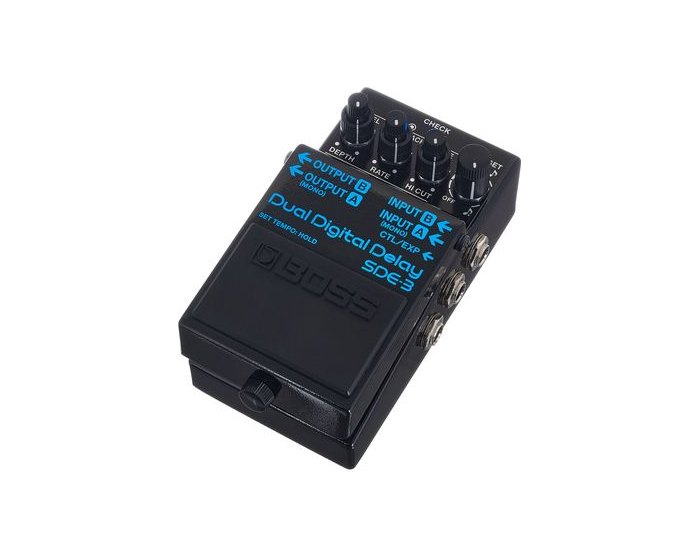
Announced in late 2024, the SDE-3 revives the spirit of the Roland SDE-3000 rack unit, the 1980s digital delay that Eddie Van Halen used on stage. It features two separately adjustable delays with advanced stereo modes (independent left and right delays or panning), up to 1,600 ms of delay time, tap tempo, and MIDI clock synchronization. Its slightly “vintage” digital character is perfect for ’80s rock sounds and wide overdubs. Price: approximately €169.
Boss DD-200
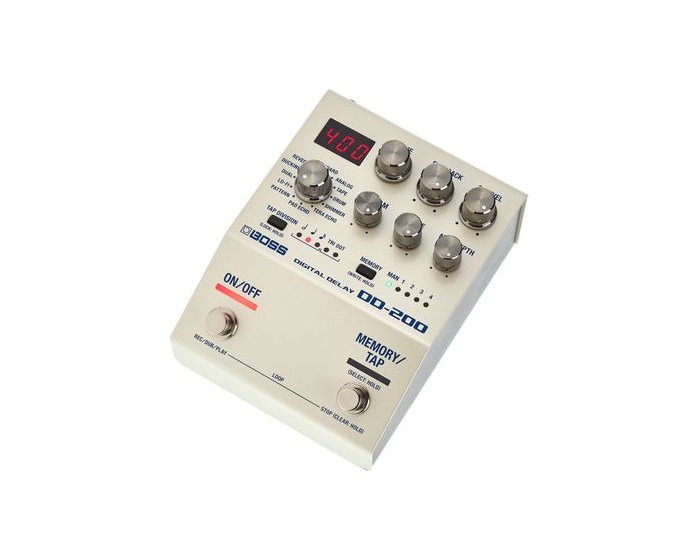
The DD-200 packs the best features of Boss’s flagship units into a mid-sized format. It offers 12 delay types—from vintage tape to shimmer—a clear display, tap tempo, 4 directly accessible presets (128 via MIDI), and 32-bit stereo audio quality. It draws 225 mA, so be sure to account for this when using a power supply. An excellent choice for anyone who wants presets and MIDI without upgrading to a dual-format unit. Price: approximately €255.
Line 6 DL4 MkII
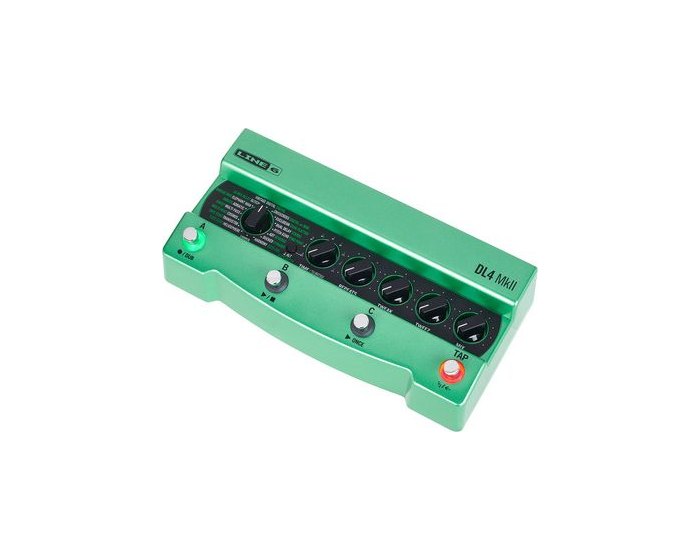
The “Big Green Machine” is back in a modernized version: 30 delay modes (the 15 classic models from the original DL4 plus 15 new ones from the HX series), hidden reverb effects, a looper with up to 240 seconds of recording time, MIDI, and 128 presets. It’s also more compact than the original, which took up a ton of space. A pedal highly prized by fans of loops and textures—and still as green as ever. Price: about €219.
3. Analog delays and their warm, grainy sound
MXR Carbon Copy Deluxe
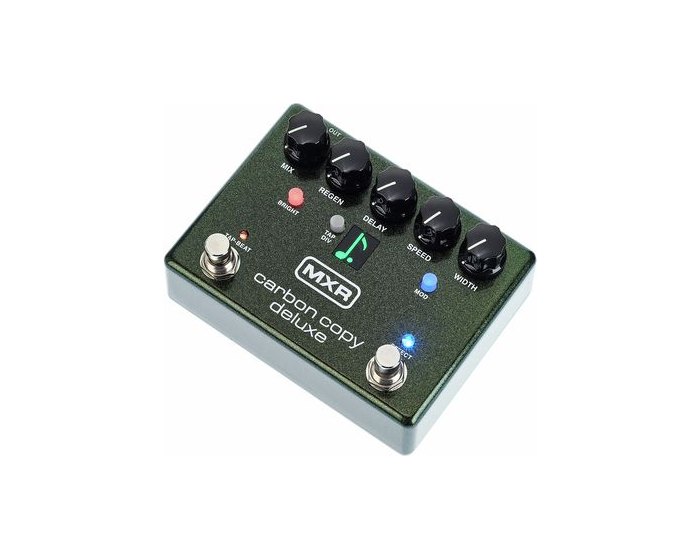
The Carbon Copy Deluxe builds on the sound of the Carbon Copy and adds what was missing for live performances: up to 1.2 seconds of delay, a tap tempo with subdivisions (eighth notes, dotted eighth notes, triplets), and a Bright mode for clearer repeats that cut through a busy mix. The modulation controls are accessible on the front panel. It strikes the right balance between analog warmth and modern convenience. Price: approximately €219.
Strymon Brig
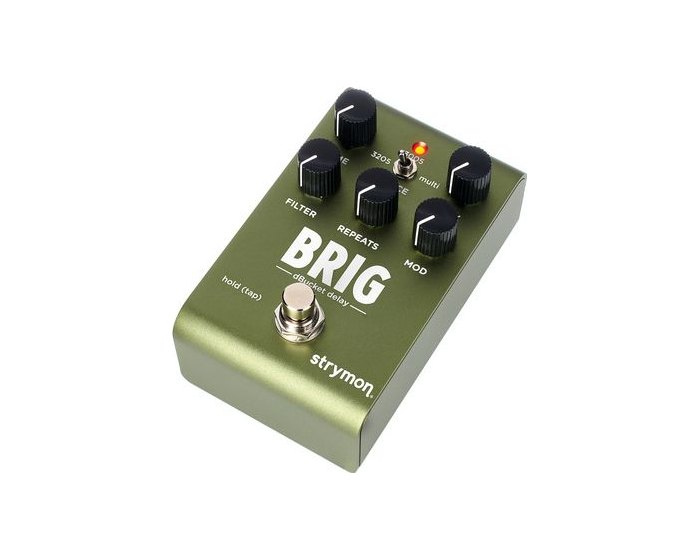
It’s hard to talk about delay without mentioning Strymon, and you’ll see that the brand comes up several times in this guide. The Brig recreates the sound of BBD-chip delays using proprietary digital processing, with three voicings inspired by the 3005 and 3205 chips and a multi-head mode. It adds features that analog can’t provide: stereo, tap tempo, and 300 presets via MIDI. The tone is warm and organic, with modern precision. Price: about €259.
EarthQuaker Devices Avalanche Run V2
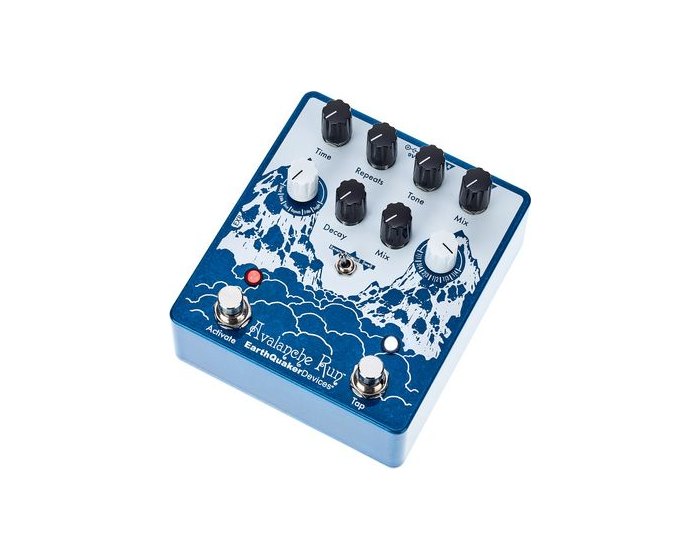
One of our personal favorites. The Avalanche Run combines a stereo delay and reverb in a single unit, featuring tap tempo, a reverse mode, and a swell mode that gently builds up the notes without an attack. It’s designed for ambient sounds: stretching pads, self-oscillating repeats, and textures worthy of an ambient album. Users especially praise the quality of its reverb, which sometimes eliminates the need for a dedicated reverb pedal. Price: approximately €459.
4. Band-Echoes and Their Simulations
Boss RE-202 Space Echo
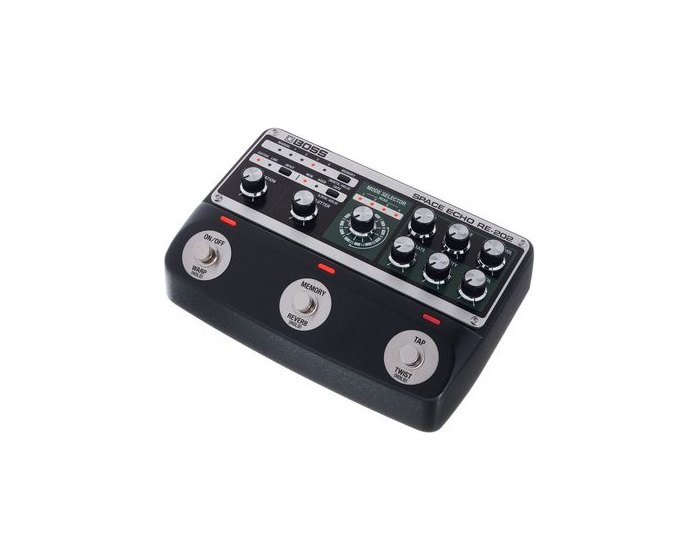
The RE-202 is a faithful reinterpretation of the legendary Roland RE-201 Space Echo, the 1970s tape echo. It reproduces its head combinations, spring reverb, and those musical imperfections: saturation, wow and flutter (slight variations in tape speed), and tape wear. It adds 127 memory slots, MIDI, and a tap tempo, all while drawing just 140 mA. A must-have for dub, psychedelic music, and all vintage sounds. Price: approximately €369.
Strymon El Capistan V2
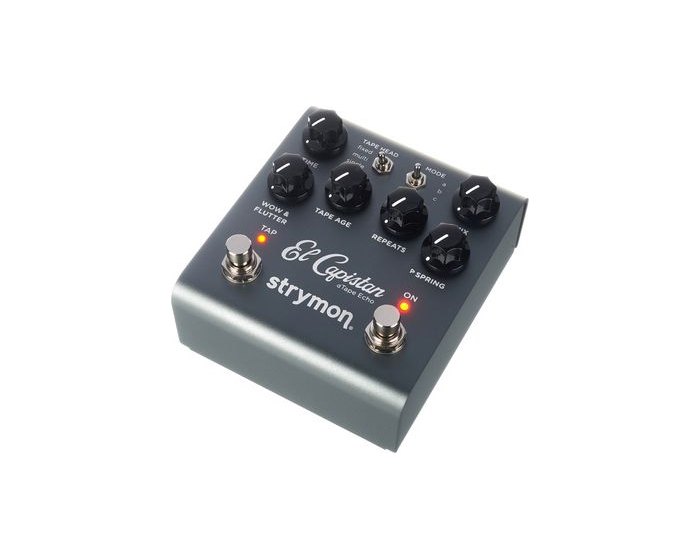
The El Capistan V2 recreates vintage tape echoes with great finesse: three types of machines (fixed-head, multi-head, and single-head), each available in three modes, inspired in particular by the RE-201 and the Echoplex. You can adjust the tape age, wow and flutter, and a built-in spring reverb. The V2 adds stereo capability, up to 300 presets via MIDI, and a USB-C port for updates. For many guitarists, it’s the best tape simulation available in pedal format. Price: approximately €419.
Universal Audio UAFX Starlight Echo Station

Universal Audio brings its expertise in vintage hardware modeling to this pedal. The Starlight features three stereo delay engines (tape, analog, and digital), tap tempo, and a storable preset, all housed in a rugged enclosure. The tape models are particularly well-liked for their saturation and their “breathing” repeats. You’ll need a 9V power supply capable of delivering 400 mA. Price: approximately €387.
5. High-end delay units
Strymon TimeLine MX
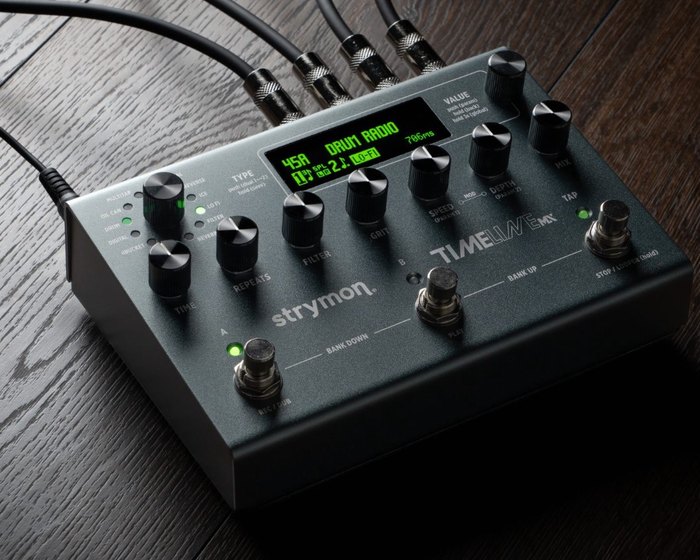
This is the big new release of 2026: set to launch in July, the TimeLine MX succeeds the TimeLine, which has been the gold standard for studio delays for over a decade. It features two engines that can be used together, 11 delay types, a reverb engine, stereo output, a 5-minute looper, and full MIDI connectivity (USB-C, TRS, and DIN). It’s a live and studio machine for guitarists who want everything in a single unit. It requires 500 mA and a substantial budget, and doesn’t yet have any customer reviews on Thomann. Price: approximately €799.
The original TimeLine is still available for purchase, featuring 12 types of delay, 200 presets, a 30-second looper, and a rating of 4.8 based on over 400 reviews: a sure bet, and significantly less expensive.
Empress Ecosystem
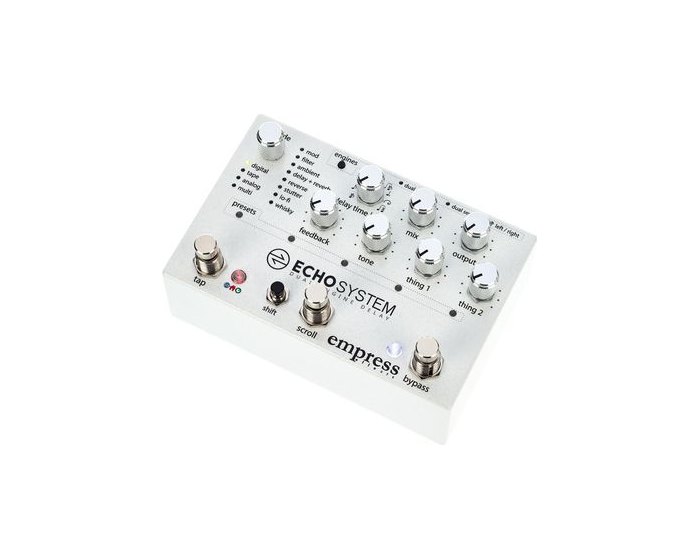
The Echosystem is a high-end stereo delay pedal built around two delay engines that can operate in series, in parallel, or as left and right stereo channels. It offers more than 40 algorithms (digital, tape, analog, reverse, lo-fi, delay, and reverb), with two knobs—“Thing 1” and “Thing 2”—whose functions change depending on the mode. The result: a vast range of sounds without endless menus. Price: approximately €525.
Meris LVX Modular Delay System
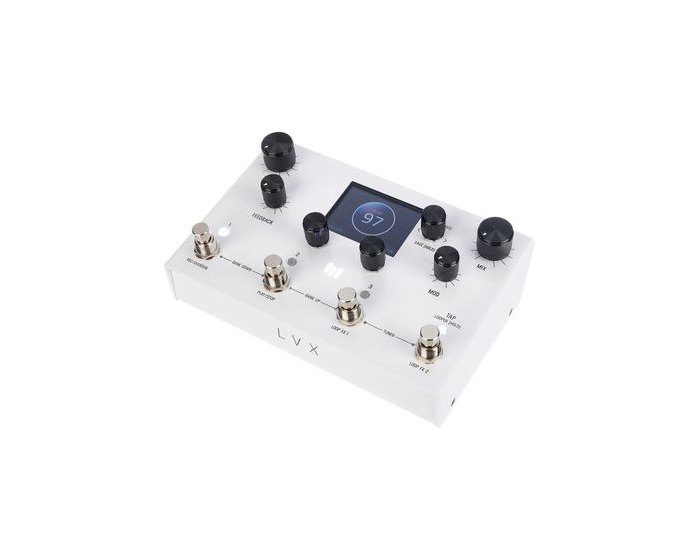
The LVX is the sound designer’s pedal. Its modular engine lets you insert effects (preamp, pitch, modulation, filter) at different points in the delay chain, creating repeats that evolve over time. It’s stereo, features a built-in stereo looper, supports presets and MIDI via DIN, and has a color display to help you navigate. It’s a fascinating machine, but it takes time to get the most out of it. Price: approximately €689.
How to Properly Adjust and Position Your Delay
A few default settings that almost always work:
- Rockabilly or country slapback: Time between 80 and 120 ms, a single repeat, mixed fairly loud.
- Solo delay: Time between 350 and 450 ms, 3 or 4 repeats, low Mix (about one-third). The echo should be felt rather than heard.
- Dotted eighth notes à la The Edge: Set the tap tempo to dotted eighth note mode, set the Mix to around 50%, and play simple eighth notes.
- Ambient: long delay, lots of repeats, slight modulation, and a touch of reverb in the background.
In terms of placement, the delay is generally placed after the gain and modulation pedals, before the reverb: this keeps the repeats clear, rather than having them distorted by overdrive. If your amp has an effects loop and you’re using the preamp to create distortion, plug the delay into the loop. For the complete setup, check out our guide to properly wiring your pedalboard, and for playing techniques, read our article on how to learn to use a delay pedal. And if you’re looking for the right reverb to follow it, our guide to choosing the right reverb pedal is waiting for you.
FAQ: Everything You Need to Know Before Buying a Delay Pedal
What’s the best delay pedal for beginners?
A simple and versatile pedal like the Boss DD-8 or the TC Electronic Flashback 2. For a very tight budget, the Harley Benton Digital Delay does the job very well.
Analog or digital delay—which should you choose?
Analog produces warm, dark tones, ideal for blues and rock. Digital is cleaner, has a longer sustain, and is more versatile, and can often mimic the analog sound.
What is tap tempo used for?
It lets you sync the delay time to the song’s tempo by tapping your foot on a footswitch. Essential for rhythmic delays during live performances.
Where should I place the delay pedal on the pedalboard?
Generally, after the gain and modulation pedals, and before the reverb. With an amp that distorts heavily, the effects loop is often the best place.
Do I need a stereo delay pedal?
Only if you’re playing through two amps, plugged into a mixing console, or using headphones. When playing in mono through a single amp, stereo doesn’t add anything.
What’s the difference between a delay and a reverb?
Delay repeats the sound distinctly, echo by echo. Reverb simulates the thousands of reflections in a room, which blend into a continuous tail.
What is a tape echo?
A tape echo, such as the Roland Space Echo or the Echoplex. Its saturated and slightly unstable repeats are now reproduced by pedals such as the Boss RE-202 or the Strymon El Capistan.
How much power does a delay pedal use?
From 40 mA for a simple delay to 500 mA for a large unit like the TimeLine MX. Always make sure your power supply can handle it.


