Chest Angina?!
Yes, the band everyone’s talking about at the moment!
Angine de Poitrine is an experimental rock duo from Quebec made up of Khn de Poitrine (microtonal guitar/bass, loopers) and Klek de Poitrine (drums). Their music blends math-rock, progressive rock and microtonal music, with a deliberately strange aesthetic of polka-dot costumes and papier-mâché masks.

The band gained international recognition thanks to a viral live session released by KEXP, featuring their hybrid double-necked instrument and an impressive arsenal of effects pedals used to build their tracks live via looping.
Their approach is based on a simple but radical idea: a single musician plays the guitar and bass parts simultaneously thanks to looping, which explains the central importance of the pedalboard in their sound identity.

The sound of Angine de Poitrine: loop-based architecture
The band’s style is based on a repetitive structure akin to electronic music: a rhythmic base played in a loop, to which various harmonic and melodic layers are gradually added.
Khn de Poitrine uses a double-necked guitar/bass modified to play in microtonality (24 notes per octave instead of 12), allowing exploration of unusual intervals inspired by oriental or contemporary music.
The microtonal double-neck guitar
The most spectacular element of the setup is a hybrid instrument combining guitar and bass on a single body.
Key features
- double neck guitar + bass
- microtonal frets for 24 notes per octave
- custom instrument built by a luthier
- phosphorescent markers to play despite the mask
- creates bass lines and guitar riffs simultaneously
This concept enables a single musician to produce a complete sound texture, close to that of a full band.
Khn uses amplification adapted to the extended frequencies of their hybrid instrument :
- Roland JC-120 Jazz Chorus
- Acoustic Control Corporation B410 MkII bass cabinet
The JC-120 is renowned for its high clarity, ideal for preserving the legibility of superimposed loops.
Chest Angina pedalboard

1. The heart of the system: loopers
Looping is the basis of the band’s sound.
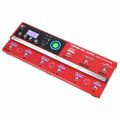
Boss RC-600 Loop Station (2 copies, while we’re at it!)
The Boss RC-600 is an extremely comprehensive professional looper, designed for complex live performances. It features 6 independent stereo tracks, MIDI synchronization, numerous built-in effects and a large loop storage capacity. Its comprehensive interface lets you build entire arrangements in real time, with remarkable rhythmic precision.
It allows the guitarist/bassist to superimpose bass lines, rhythmic patterns and melodic textures.
The RC-600 also lets you assign different loops to separate outputs, which may explain the simultaneous use of guitar and bass amplification.
 Boss RC-600 Loop Station468 €Buy
2. Saturation and texture effects
To create a dense, hypnotic sound, several gain pedals are used. These effects create an organic grain that contrasts with the repetitive aspect of looping.
ProCo RAT 2 Distortion
The ProCo RAT 2 is a cult distortion pedal known for its aggressive grain and great versatility. It can produce both rough overdrive and dense saturation, ideal for alternative or experimental styles. Its filter allows you to fine-tune its presence in the mix.
Used by Angine de Poitrine, it adds the abrasive texture characteristic of their repetitive patterns.

 Proco Rat 2 Distortion95 €Buy
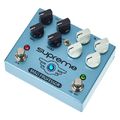
Mad Professor Supreme Overdrive
The Supreme is a high-end overdrive with a rich, dynamic grain, capable of adding character without masking the nuances of playing. The result is a warm, precise sound, particularly suited to complex configurations.
In the Angine de Poitrine project, it is probably used to thicken the signal before the loopers, to give more presence to the layers of sound.
 Mad Professor Supreme Dual Overdrive279 €Buy
Fender Engager Boost
The Engager Boost is a transparent boost pedal that increases signal level without greatly altering timbre. It incorporates an active EQ for fine-tuning frequencies. It is often used to make certain parts stand out in the mix.
It highlights certain loops or melodic passages in Angine de Poitrine’s compositions.
3. Pitch and synthesis effects
An important part of the sound is based on the transformation of the guitar signal into quasi-electronic textures. The ring modulator contributes to the band’s characteristic dissonance.
MXR M288 Bass Octave Deluxe
MXR Bass Octave Deluxe adds a lower octave to thicken the signal considerably. Highly precise in note tracking, it retains good definition even when playing fast. It transforms a guitar into a bass-like instrument.
In Angine de Poitrine, he generates bass lines from the guitar to fill out the sound spectrum.

 MXR M288 Bass Octave Deluxe159 €Buy
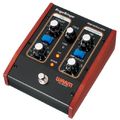
Warm Audio RingerBringer Ring Modulator (probable)
The Warm Audio RingerBringer is an analog ring modulator inspired by the famous Moog MF-102. Thanks to its internal oscillator and integrated LFO, it can profoundly transform the signal by generating metallic, dissonant or synthetic frequencies. Widely used in experimental music, it allows you to obtain textures that are radically different from a traditional guitar sound.
In the Angine de Poitrine setup, he plays a major role in the band’s sonic identity, contributing atypical electronic textures and timbres, often modulated in real time via several expression pedals.
 Warm Audio RingerBringer Ring Modulator211 €Buy
4. Modulation and ambience effects
The spatial effects contribute to the hypnotic aspect of the mantra-rock:
Boss DD-8 Digital Delay
The DD-8 is a modern digital delay with many modes: analog, reverse, shimmer or modulation. It creates perfectly tempo-synchronized repeats and adds depth to the signal. Its versatility makes it a popular tool for atmospheric textures.
For Angine de Poitrine, he reinforces the hypnotic effect of the repetitive motifs by adding a spatial dimension.
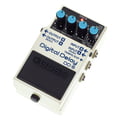 Boss DD-8 Digital Delay179 €Buy
Pike Amplification Vulcan XL
The Vulcan XL is a boutique effect designed to transform the signal into a more synthetic or filtered texture. It can be used to shape timbre in an original way, creating hybrid sounds between guitar and synthesizer.
For the band, it contributes to the project’s experimental sound signature. It’s an important part of the band’s sound!
5. Expression controllers
Moog EP-3 Expression Pedal (4 copies, yes, yes!!)
The Moog EP-3 is a robust and precise expression pedal for real-time control of various compatible effect parameters. It can influence the frequency of a filter, the speed of an LFO or the intensity of an effect. Widely used in sound-design-oriented setups, it adds a truly expressive dimension to pedalboards.
Use by Angine de Poitrine: several pedals are assigned to the ring modulator’s Mix, Freq, Rate and LFO parameters toprofoundly modify the live sound texture. A real gas factory!
Boss FV-50H Volume Pedal
The Boss FV-50H is a robust volume pedal for precise signal level control. It is often used to create progressive transitions, manage dynamics or balance different instruments in a complex setup. Its simple, reliable design makes it a standard on many professional pedalboards.
In the Angine de Poitrine setup, it allows the loops to evolve progressively, creating highly musical variations in intensity.
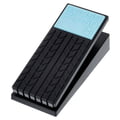 Boss FV-50H79 €Buy
6. Tuner and utilities
Even in an experimental setup, certain standards remain indispensable:
Boss TU-3 Chromatic Tuner
The TU-3 is a precise, robust tuner that has become a standard on professional pedalboards. It features a high-quality buffer that keeps the signal clear even with long effects chains. Its legibility under live conditions is excellent.
Essential for accurate tuning of microtonal instruments.
 Boss TU-395 €Buy
Radial BigShot ABY
The Radial BigShot ABY lets you send the signal to two separate channels or select a specific output. It guarantees a clean signal with no loss of quality, and facilitates complex multi-amp or multi-effect configurations.
It can be used to separate guitar and bass streams for different processing.
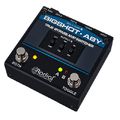
 Radial Engineering Tonebone Bigshot ABY/Y MKII155 €Buy
Boss DB-90 Metronome
The Boss DB-90 is a professional metronome capable of sending a tempo signal via MIDI. It can be synchronized with a looper to guarantee perfect rhythmic precision in live performances.
It allows the drummer to play perfectly synchronized with the loops triggered by the RC-600.
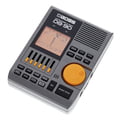 Boss DB-90159 €Buy
Probable signal chain
Although the exact routing is not fully public, the chaining structure can be guessed:
Microtonal guitar/bass
→ tuner → octaver → overdrive / distortion → ring modulator → delay → loopers (x2)
Amplification
What makes this pedalboard unique?
The Angina pectoris setup is distinguished by several elements:
1. An orchestral approach: the pedalboard almost replaces an entire band, allowing parts to be superimposed.
2. A logic closer to electronic music: hypnotic repetition reminiscent of techno or ambient.
3. A deliberately strange sound aesthetic: micro-intervals and ring modulation produce unusual harmonic tensions.
4. A simultaneous guitar/bass mix: the instrument’s dual function completely transforms the traditional pedalboard approach.
How do I get close to the sound of Angina de Poitras?
To get closer to this type of sound :
A few essentials…
- an advanced looper
- an octave pedal
- RAT-like distortion
- precise digital delay
- an atypical ring modulation pedal
- a differently tuned guitar or baritone
But in truth, it’s all about the game and the approach:
- working with repetitive patterns
- progressively superimpose layers
- focus on complex rhythms
- use effects as instruments
Angine de Poitrine’s pedalboard perfectly illustrates the modern evolution of the guitar into a hybrid instrument between rock and electronic music. Thanks to a combination of loopers, experimental effects and custom microtonal instruments, the duo succeed in creating an immediately identifiable and absolutely unique sound universe.
More than just a pedalboard, it’s a true real-time composition system, enabling 2 musicians to produce dense, immersive and radically original music.