The phaser effect remains a pedalboard staple, bringing that wave motion, sonic waves, fluid sweep that instantly enriches a guitar sound. In 2025, phaser pedals have reached an impressive level of maturity: from vintage analog circuits to ultra-fine stereo digital devices, they cover every style, from funk to psychedelic rock, ambient to modern pop.
This guide is designed to help you make sense of the situation, understand the criteria you should be looking for, and discover 10 Phaser models that will be essential in 2025.
What is a phaser pedal?
A phaser pedal modulates the guitar signal by creating phase shifts between certain frequencies. In concrete terms: a low-frequency oscillation (LFO) modifies the point of phase shift in the spectrum – this creates a sweep that gives that “wave” effect. Unlike a flanger (which uses a short time delay) or a chorus (which doubles the slightly shifted signal), the phaser remains more subtle, more organic, more “undulating”.
It’s used to give movement, air and breath to a static sound; to create soaring textures or give a solo a swirl. Well placed (often before delays/reverbs), it can subtly transform a “flat” sound into a rich ambience.
The different types of phaser
Analog
Analog phasers are based on components such as JFETs, OTAs and transistors, and offer vintage warmth, sometimes subtle saturation and slight circuit instability. Example: classic models from the 70s.
Digital (or hybrid)
Digital or hybrid models offer greater flexibility: stereo, presets, MIDI, tap-tempo, fine controls (feedback, mix, etc.). They allow you to reproduce vintage sounds and go even further.
Multi-stage and stereo
The number of stages (4, 6, 8, 12…) determines the complexity of the phasing: the more stages, the wider the sweep, the more pronounced the sonic buzz. Stereo models add an even more immersive spatial effect. For example, a pedal with two independent sections can be used to chain several types of modulation.
How to choose the right phaser pedal?
Here are the criteria to keep in mind:
- Musical style: If you play funk, soul or classic rock, a simple 4-stage analog phaser may suffice. If you’re into ambient, shoegaze or experimentation, go for a stereo or multi-stage model.
- Number of stages / type of modulation: a 4-stage phaser will have a lighter, more subtle movement; a 6-, 8- or 12-stage phaser will have a more pronounced effect.
- Controls available: Classic controls: rate, depth, feedback/resonance (feedback/peak), mix (dry/wet), possibly stage or mode. The more settings you have, the more you can fine-tune your sound (which also makes it much more complex to use, especially live). For example, the Boss PH-3 model: choice of 4/8/10/12 stages + Rise/Fall modes.
- Bypass & pedalboard integration: True bypass or buffered? Format, power consumption, stereo capability, or left/right output.
- Budget: There are affordable phasers (around €100-150) and top-of-the-range models (€300-400 or more). The difference often lies in build quality, features (stereo, MIDI, presets) and components (hand-wired, boutique).
- Integration into your setup: where should the pedal be placed in the chain? Usually after drive/overdrive and before delay/reverb, so that the sweep remains audible without being drowned out.
Our selection of the 10 best phaser pedals of 2025
Here are 10 models that we consider must-haves today, each with its own specific features, benefits and recommended uses.
Strymon ZelZah Dual Phaser

This Strymon model is a monster of versatility: 2 independent sections (a 4-step phaser + a 6-step stereo phaser) that you can use separately, in series or in parallel.
It offers high-end control: JFET analog input, 24-bit/96 kHz conversion, USB/MIDI, mix, expression, presets. Ideal for pro guitarists, in studio or live, who want an ultra-complete, stereo phaser for textures ranging from subtle vintage to immense modulation.
Please note: fairly high cost (€359 at the time of going to press), requires substantial power supply (≈300 mA).

 Strymon ZelZah Dual Phaser359 €Buy
MXR Phase 90

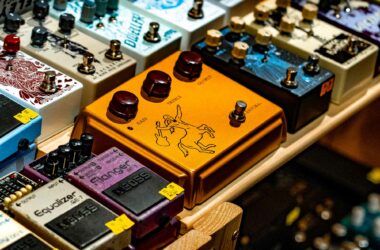
A true icon, no more, no less. MXR’s classic model (M101) is a simple analog phaser with a single Speed knob. Its FET transistor circuit and orange design are legendary.
Ideal for anyone who wants a vintage phaser that’s efficient and uncomplicated. Funk, classic rock, fast riffs.
Note: few settings, mono, simple. What else is there to say?

 MXR Phase 9095 €Buy
MXR 1974 Vintage Phase 90

This “hand-wired” reissue of MXR’s original 1974 model faithfully reproduces the vintage “script logo” circuit, with NOS components and hand-crafted finish. Ideal for purists, collectors and fans of authentic 70’s sound.
Please note: higher budget than standard version, more limited production run. We’ll let you decide for yourself whether this version is better than the classic MXR Phase 90… Comment away!
 MXR 1974 Vintage Phase 90166 €Buy
Boss PH-3 Phase Shifter

The consumer digital phaser from Boss. It covers several modes (4, 8, 10, 12 stages) + unidirectional “Rise” and “Fall” effects, tap-tempo or expression pedal. Ideal for versatile, live guitarists looking for lots of variation in a reliable, compact format.
Please note: bypass buffered (not true bypass), digital sound sometimes considered “colder”. We’ll let you make up your own mind 😉 !

 Boss PH-3135 €Buy
Warm Audio Mutation Phasor II

What a look! The Warm Audio model is inspired by vintage phasers and often features a rich analog sound with a jet phaser section. Ideal for a moderate budget (good quality/price ratio) and a pronounced vintage sound.
Note: less “high-end” styling/stereo than the pro models.

 Warm Audio Mutation Phasor II144 €Buy
Walrus Audio Fundamental Phaser

This Walrus Audio model offers 3 modes (Light, Medium, Heavy) in a simple but effective format. Ideal for a first phaser or for guitarists looking for a versatile, clear, well-made model.
Please note: digital (sometimes referred to as “digital recreation of analog circuits”), but very musical.

 Walrus Audio Fundamental Phaser109 €Buy
Walrus Audio Lillian Analog Phaser

An analog phaser from Walrus Audio, more high-end than the Fundamental, with 4 or 6 stages and a more boutique sound. Ideal for those who want a qualitative analog phaser with character, dream-pop and psychedelic textures.
Note: higher budget and slightly more demanding and precise settings.
EarthQuaker Devices Grand Orbiter V3

This model from EarthQuaker Devices is 100% analog, 4-stage OTA, with Phase / Vibrato switch, LFO kill mode for resonant filter, full control (Rate, Sweep, Resonance, Depth).
Ideal for creative musicians, ambient, experimental, slow textures or extreme movement.
Please note: larger format, higher budget, not battery-operated (9 V DC power supply required).

 EarthQuaker Devices Grand Orbiter V3249 €Buy
Warm Audio Jet Phaser

Inspired by a legendary phaser (Roland AP-7 / Jet Phaser), this pedal combines an integrated phaser + fuzz section, perfect for funk/psych/bass sounds. Ideal for bassists or funk/rock guitarists who want a phaser + fuzz texture in the same box.
Please note: a little more specific in its use (less “universal modulation”).
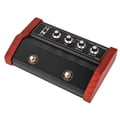 Warm Audio Jet Phaser99 €Buy
TC Electronic Helix Phaser

TC Electronic’s Helix Phaser remains a benchmark among modern digital phasers. TonePrint compatible, it lets you load custom presets via USB and access a vast palette of sounds from soft analog phaser to intense psychedelic sweep. True bypass, stereo and built like a tank, it seduces with its clarity and versatility. Perfect for guitarists looking for a flexible, precise phaser, ideal for both studio and live use. Unfortunately, it’s no longer in production!
FAQ – Phaser pedals
What’s the difference between a phaser and a flanger?
The flanger uses a short delay and generates a more “metallic” effect, like an airplane or jet plane. Phaser, on the other hand, modifies frequencies via phase shifting, producing a more fluid, “wave-like” effect.
Where to place a phaser in the effects chain?
Traditionally after overdrive/distortion, before delay and reverb, so that the sweep remains clear, without being swallowed up by the following effects.
Analog or digital?
Analog = warmth, simplicity, often fewer controls.
Digital = flexibility, stereo, presets, but sometimes cleaner sound.
What’s your budget?
Good models are available from ~100 €, but for high-end features (stereo, dual-channel, presets) the budget rises to ~300-400 € or even more.